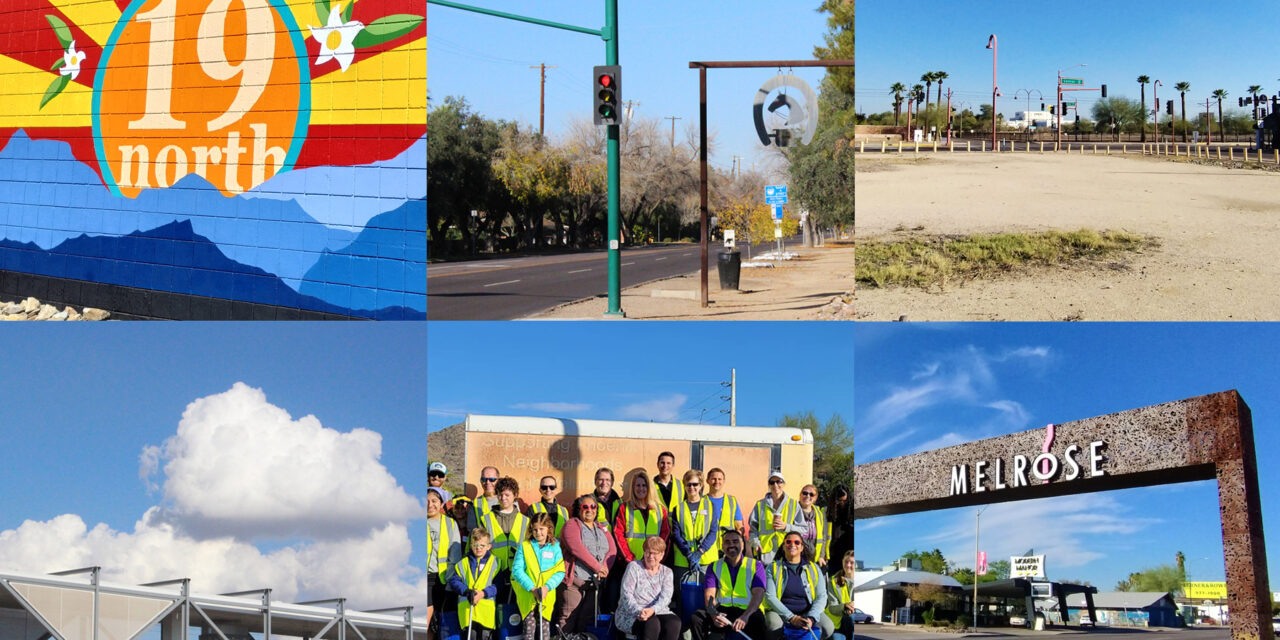
North Central Phoenix’s neighborhoods, and the challenges facing them, are as unique as the neighbors themselves – from the Carnation neighborhood to Metrocenter and everywhere in between. But there is one thing that they all have in common: great things can happen when neighbors work together to bring about a transformation.
While there are hundreds of associations and block watch groups across the city, here is a snapshot of some of the positive things happening in just six neighborhoods, from the volunteers who serve them, as well as citywide, from a group that advocates on behalf of neighborhoods throughout the Greater Phoenix area.
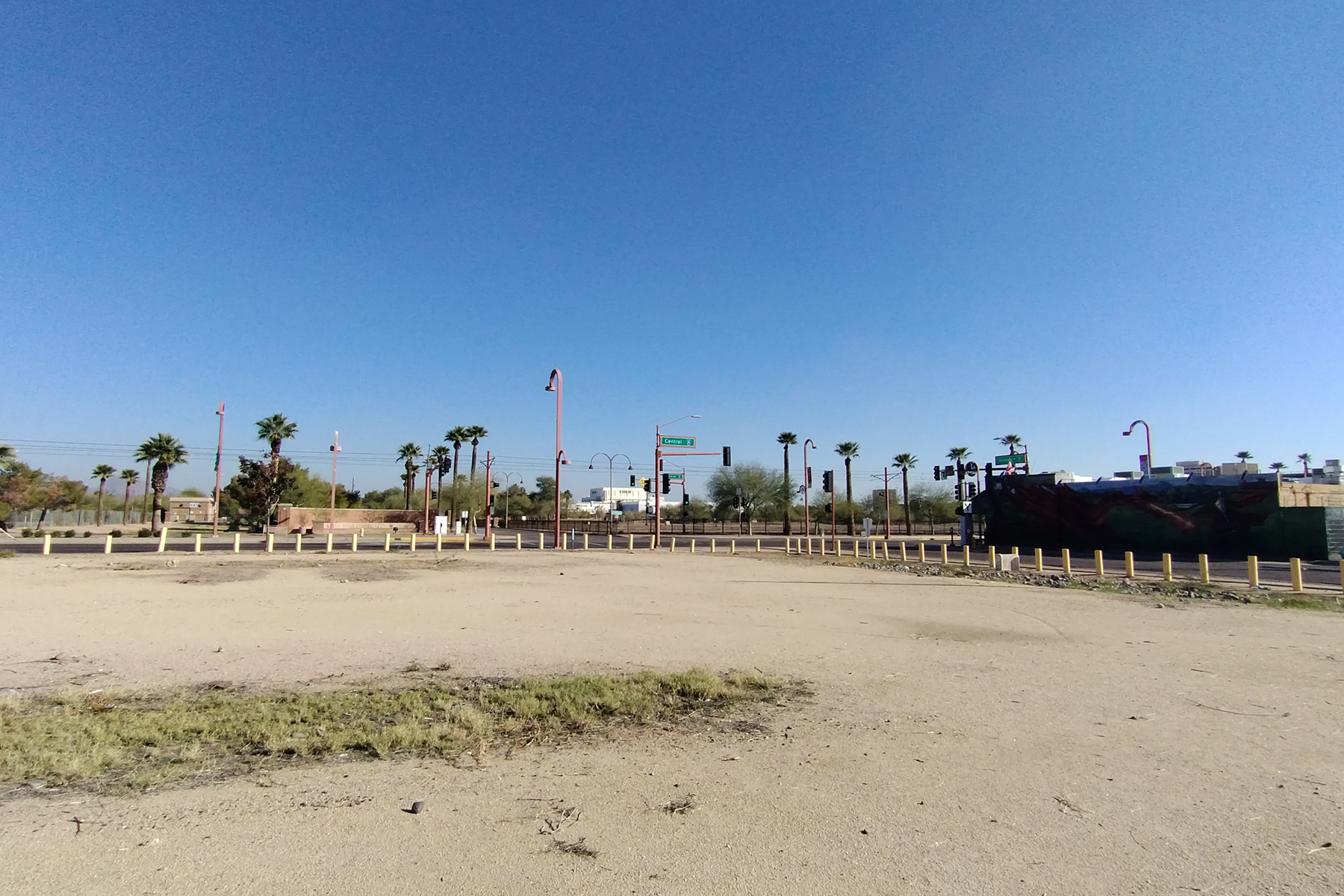
Looking southeast towards the intersection of Central and Glenrosa avenues, an area within the Carnation Neighborhood that will see major changes in the coming years (photo by Kathryn M. Miller).
Carnation Neighborhood
Also known as CAN, the Carnation Association of Neighbors was reformed in 2018 after a grant supporting the area’s alley lights expired and neighbors were inspired to restart the association. CAN’s boundaries are between 7th and Central avenues from Indian School Road north to the Grand Canal.
“In 2023, we had many wonderful community events, such as our annual bike rides and pancake breakfast, where our neighbors met and built community,” said Ed Hermes, CAN president. “Our neighborhood continues to be one where neighbors connect, become friends, and lookout for one another.”
Hermes points to a number of 2023 wins for the neighborhood’s advocating efforts, including repaving and new striping on 3rd Avenue to encourage walking and biking and to calm traffic. The neighborhood also saw improved bike lanes on 3rd Avenue south of the neighborhood (between Indian School and Thomas) — steps in the right direction, Hermes says.
“The dream of our community has been and continues to be to provide an option along 3rd Avenue to bike safely to downtown, where many of our residents work,” he said.
Other wins include commitments by the developer of the large empty lot in the neighborhood to pay for the installation of much needed sidewalks and traffic calming measures and getting the needed petition signatures to get a missing piece of sidewalk built on Monterosa between 3rd and 2nd avenues. But that sidewalk win came with its own challenges.
“The City of Phoenix says it will be four years before they will actually install the sidewalk because they are backlogged,” Hermes lamented.
They have had challenges building neighborhood consensus and negotiating with developers of two large lots along Central Avenue, one at Indian School Road (The Central Park) and another at Glenrosa Avenue (Petree development), but he appreciated the engagement of neighbors and their efforts to get better outcomes for the developments and he remains hopeful that they can build that much-needed consensus to meet future challenges.
Looking ahead, CAN will remain involved in future developments, with a focus on connectivity and safety in and around the neighborhood, continuing their work to make it safe and enjoyable to commute, walk, bike and engage with neighbors. They will also launch a partnership with other area stakeholders to upgrade Steele Indian School Park, and they are actively involved in the movement to end the rush hour reverse lanes on the 7s (7th Avenue and 7th Street).
Learn more at www.carnationassociationaz.com.
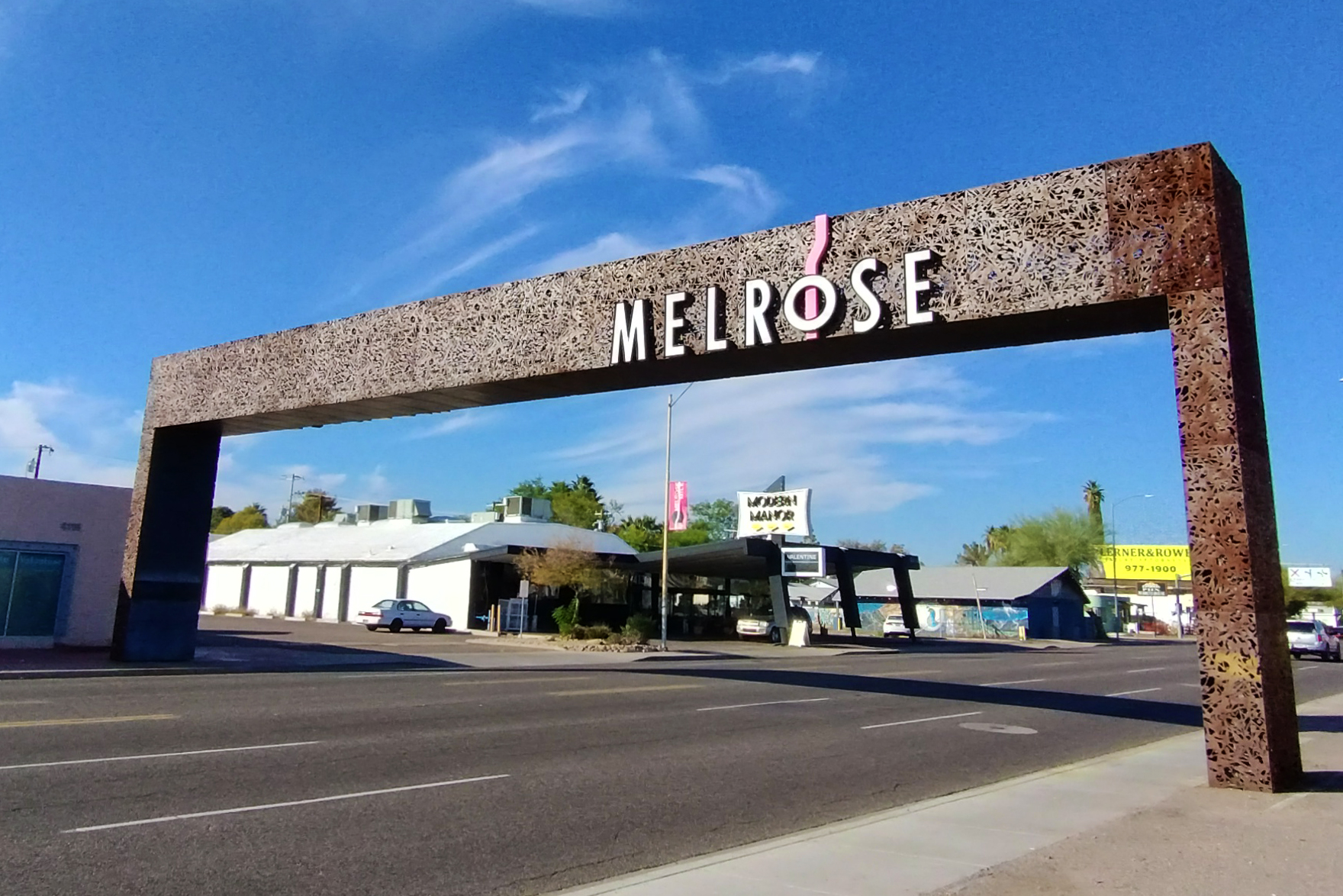
The iconic Melrose sign welcomes neighbors and visitors alike to the Melrose Mile, which runs from Indian School Road north to Camelback Road (photo by Kathryn M. Miller).
Melrose District
On the western border of the Carnation neighborhood is one of the most distinctive areas in the city, the Melrose District. The Melrose Mile, along 7th Avenue from Indian School to Camelback Road, has maintained its old-school vibe, and unique, locally-owned businesses abound — from antique and resale shops to art galleries, diverse dining and cocktail lounges and a broad variety of services.
Robb Oliveri, president of the decade-old Melrose Community Alliance, says that the area is unique to anywhere that he has been, “And I think it’s the people that make it that way,” who he says are from incredibly diverse backgrounds. And between the people and the character of purposeful adaptive reuse, Melrose maintains a special sense of place.
The Alliance works with the Melrose Merchants Association, neighbors and other area groups along the Mile and between 15th to Central Avenue to maintain the welcoming atmosphere in the neighborhood.
“We’ve got some pretty robust neighborhoods in and of themselves,” Oliveri said. “So, for us, it’s not only bringing the neighbors together from the respective neighborhoods and along with the businesses on the street, but also providing access to resources.”
The group hosts regular events where they bring in City of Phoenix departments to talk about issues in the area and some of the resources that the city and other private organizations have to offer. For example, they host Safety Summits to address crime prevention, and they bring together the various neighborhood representatives to exchange information and ideas.
The Alliance also does “purely social, fun stuff” to bring the community together, most recently hosting a Christmas tree lighting event, working in conjunction with the Merchants Association’s Merriment in Melrose, at The Lyceum, an area pocket park that they helped establish. Looking ahead, one of the biggest events each year by the Merchants, the Melrose Street Fair (www.melrosemerchantsassociation.com), will return March 2.
Learn more at www.melrosecommunityalliance.com.
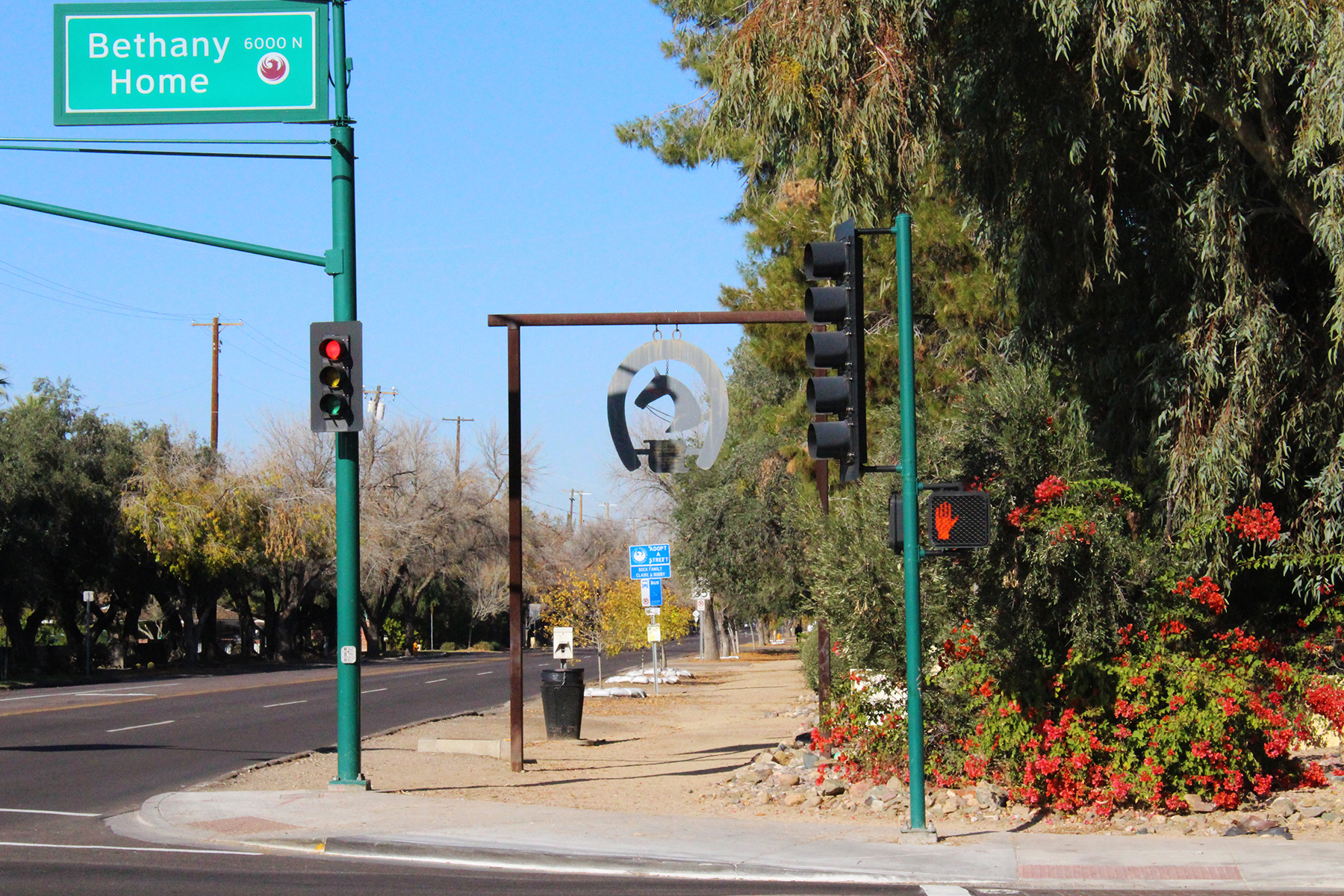
The northeast corner of Bethany Home Road and Central Avenue serves as a gateway to North Central’s Murphy Bridal Path (photo by Kathryn M. Miller).
North Central Neighborhood
One of the older neighborhood groups in the area, the North Central Phoenix Homeowner’s Association was founded close to 50 years ago. The neighborhood boundaries are from the north side of Missouri Avenue to the south side of Northern Avenue; the east side of 7th Avenue to the west side of 7th Street.
The venerable neighborhood is known for its tree-lined streets, Murphy Bridal Path and large irrigated lots, some with historic homes dating as far back to the late 1800s. Mary Crozier, current president of the association, says that their primary focus is on retaining that residential charm and character of the neighborhood from inappropriate development, whether it be residential or commercial.
“Our board, which is a volunteer board, has really tried to keep the character and the charm and the integrity of North Central to be predominantly residential, Crozier said. “We feel that having residential neighborhoods so close to a major downtown area is such a unique attribute.” Crozier adds that they support appropriate growth and development, but, “As the city grows, areas like ours become more vulnerable because developers want to build in areas that are recognized as holding their value, but they want to come in and oftentimes change it.”
One major, ongoing undertaking for the neighborhood has been to maintain the dense tree canopy along Central Avenue, which from Bethany Home to the canal is nationally, historically designated.
“What’s unique about Central Avenue is that it is an arterial street, but it’s the narrowest arterial street in the city,” Crozier said. “It is historically designated both sides of the street, including the irrigation lateral, The Murphy Bridle Path, the ash trees in the city right of way and the olive trees, which border property lines on both the east and west side of the street, those are all historically protected.”
Over the last couple of years, the group has replaced over a hundred trees that were dead or diseased, and the work continues, “We feel like North Central is about 8 to 10 degrees cooler than the rest of the city because of all our tree canopy,” she added.
The association works to make sure developments adhere to the North Central Avenue Special Planning District overlay, which they helped establish in 2004, they produce two newsletters a year, hold monthly board meetings and an annual meeting, work with other associations on broader issues and serve as a resource for residents throughout the year.
Looking ahead, the group will work with the city to find solutions to repair some of the erosion on the Murphy Bridal Path, improve the Bethany Home gateway, as well as work to bring more members into the volunteer organization.
“We’d really like to get the next generation of property owners to step up and hopefully continue what people before me had done 50 years ago,” Crozier said. “And we’ll continue to protect this neighborhood because it is such a gem. I feel so fortunate to live here.”
Learn more at www.ncpha.org.
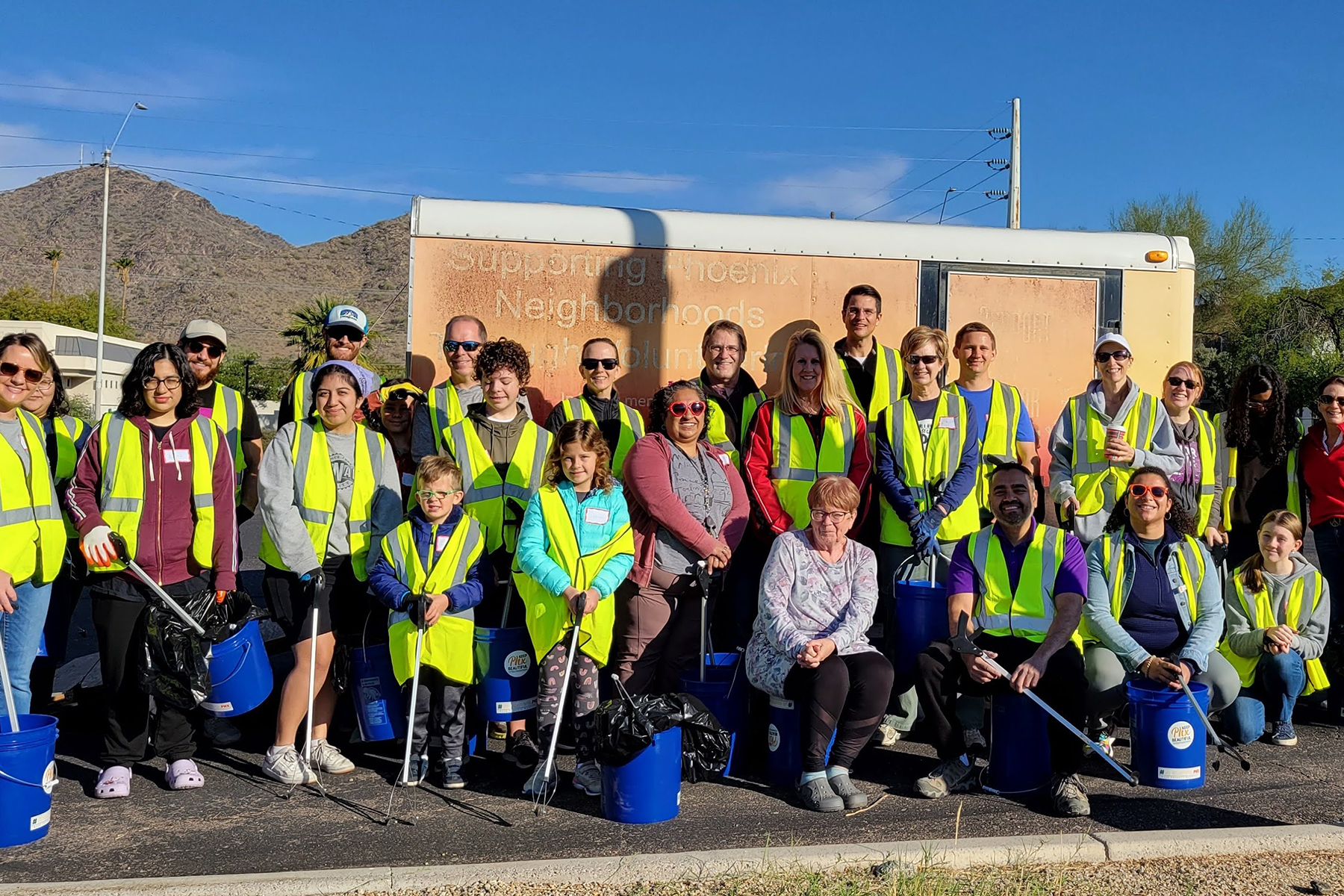
In early December 2023, neighbors and community leaders joined forces to clean up Sunnyslope’s Hatcher Road area in advance of the annual Slope Holiday Market & Parade (photo courtesy of theHUB).
Sunnyslope
Just north of the canal is another unique gem of an area, Sunnyslope. There are a number of active associations working in the area, and two of them offered their unique perspective — Hatcher Urban Businesses (HUB) and PHXLuv.
Launched in 2018, the HUB is a group of business owners, property owners and residents along Hatcher Road who are working to revitalize the area along Hatcher east of 19th Avenue to 12th Street.
“We have about 150 small and microbusinesses on Hatcher,” said Caroline Lobo, president of HUB, “and our role is to revitalize the Hatcher corridor in a way that the existing businesses could flourish and we could also attract new development and diverse business types.”
The organization is actively seeking to brand the area in a way that people will be attracted to open shop there — potentially as a design district, Lobo says, that would also include small coffee shops and diverse retail.
“A lot of the businesses are hands-on makers, and Sunnyslope has a lot of artists. So, we are hoping to rebrand it so that we can attract these diverse businesses on the Hatcher corridor,” she said. “It’s about timing. A lot of the businesses that have been here for 50-plus years are turning the corner, they are hoping to sell. So, we are hoping that this is an opportunity to rebrand, recreate and give it a sense of community where people can live, work, play and shop in their communities.”
She added, “I think it is very unique in the sense of walkable streetscape — you’ve got the mountain on one side, you’ve got the canal on the other side, and these vistas that are so beautiful. It’s got the bones to make it a real destination.”
The HUB is also building community through annual events, such as the Slope Holiday Market & Parade, held for its second year in 2023. The event celebrates the season and hopes to get younger generations invested in Sunnyslope. They also host monthly community meetings, frequent clean-ups and other events, and are actively working to increase the shade canopy and bring more art to the area.
“I would encourage residents and business owners alike to really take the time to come to a meeting, to come to an event,” said Nadine Alauria, who is vice president of the HUB and also sits on the board of the West Sunnyslope Neighborhood Association and Block Watch. “I can promise, anyone who takes the time to do that, they will be so happy they did, and pleasantly surprised at just how amazing the community is, the friends that you make and how enjoyable it is just to meet other people who want to improve their neighborhood…improve their community.”
Learn more at www.sunnyslopehub.com.
PHXLuv a community-based organization focused on “helping make the world around us a better, happier place” by building community through public safety, art and civic engagement. Currently led by Stacia Hurst, PHXLuv restarted in 2019 and is bounded by Peoria Avenue south to Mountain View Road; Cave Creek Road west to 7th Street. They work with many of the other active Sunnyslope groups, such as the East and the West Sunnyslope Neighborhood Association and Block Watch groups, and many other smaller groups are getting involved.
For Hurst, it is the diverse mix of people, businesses, walkability and bikeability that makes the Sunnyslope area attractive.
She adds, “I live over by North Mountain Park, and it’s just a really sacred space. I like being able to walk around the trails and the canals,” which have seen a decline in safety over the years, she says, “But that’s why we started, that’s why we’re doing all this.”
PHXLuv does their best to keep neighbors informed, and their website offers a wealth of information — from a calendar of area events and neighborhood group and block watch information, to an ongoing list of zoning adjustment notices and dozens of links to resources on a variety of topics.
She hopes that neighbors will get more civically engaged, especially with zoning issues, and as groups address challenges in the area, Hurst says that feedback from neighbors is crucial to focusing on priorities in the neighborhood.
“Nobody can do all of the work, but everybody can do a little bit. We can all collaborate on what needs done.”
Learn more at www.phxluv.com.
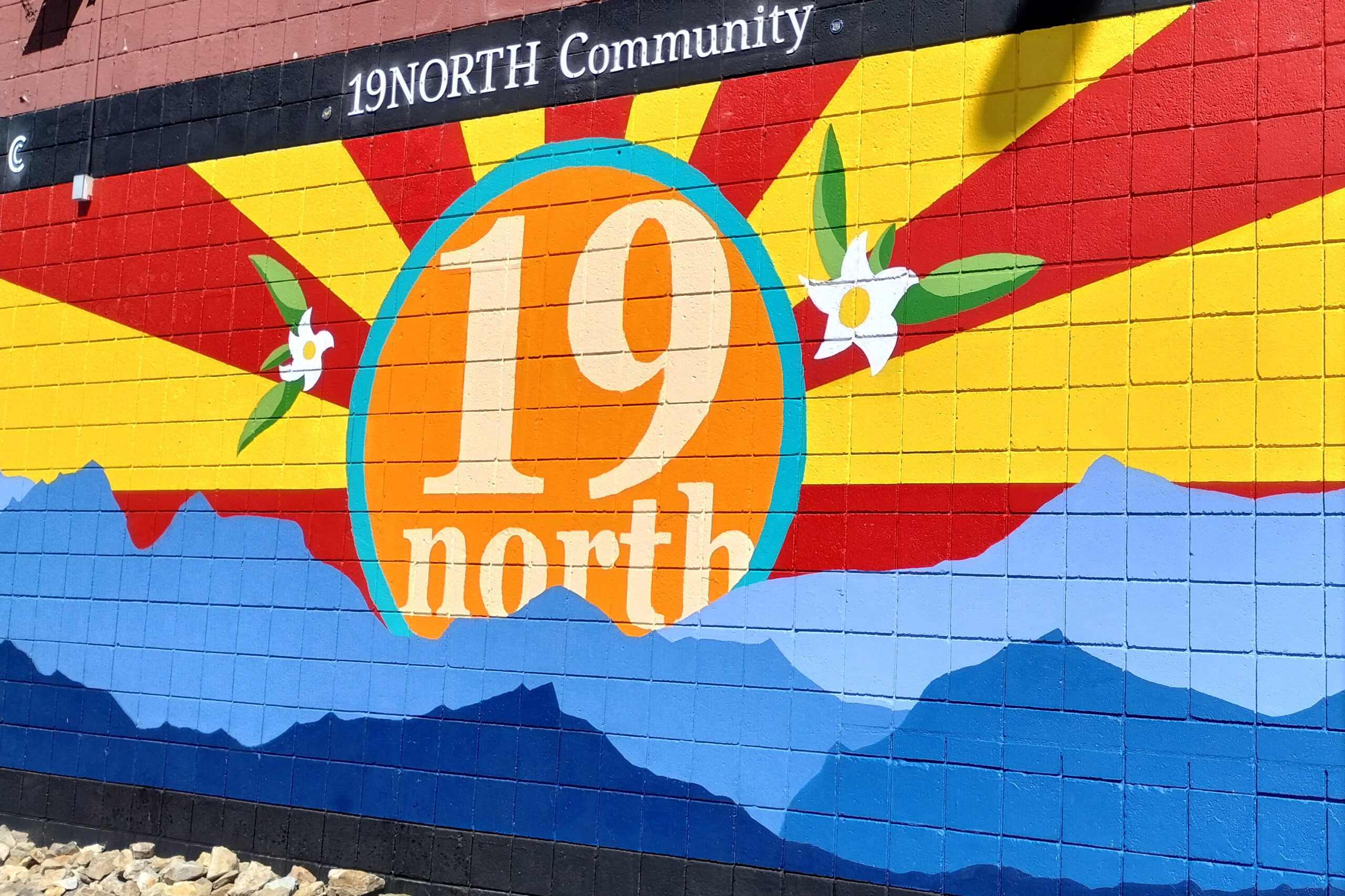
In March 2023, neighbors in the 19North area celebrated a new mural, which was created by local Eagle Scout Carter Chase (photo by Kathryn M. Miller).
19North & Metro District
With the completion of the Northwest Extension Phase I of the Valley Metro Light Rail, and under the leadership of Shannon McBride, the 19North Community Alliance was formed in 2016. The coalition of community leaders, city officials, faith and nonprofit organizations, schools, businesses, and other residents came together to create a shared vision for the neighborhood bounded by 15th Avenue to 23rd Avenue, Montebello Road to Dunlap Avenue. The boundaries have since expanded west to I-17.
In 2018, the City of Phoenix, Valley Metro and the Alliance came together to create the 19North Transit Oriented Development District Policy Plan, and continued the work of officially branding the district. McBride considers herself a “facilitative leader” for the area — there are a number of organized neighborhood groups that 19North collaborates with, including the Royal Palm Neighborhood, Washington Park Neighborhood and State Avenue Block Watch, among others.
As the light rail continued its move west under Phase II of the extension, the Alliance’s efforts moved with it and the Metro District Community Collaboration was founded in 2021. Now, work is underway at the City of Phoenix to create the Northwest Extension Phase II Transit Oriented Development plan.
“It’s really about just making sure that we’ve got the pulse of the community, what they would like to see developed, redeveloped, stabilized. And that we’re engaging groups with great intentionality so that when it’s all said and done, it becomes their vision — not the city’s vision, their vision,” said McBride. “So, this first phase is really just making sure we’ve got a lot of stakeholders engaged: kids, developers, the city. I mean Streets [Department] should be part of the conversations and the Neighborhood Services Department and the police, you know just making sure we’ve got all the players, knowing that we’re drafting a vision for the area.”
Both areas have seen many changes in the past year and still face ongoing challenges. One answer to those challenges is a Public Safety Collaboration that was launched in 19North and is now in the works in the Metro District. The program brings together area businesses to pool their resources to hire private security — an effective layer of deterrent to make communities safe, McBride says.
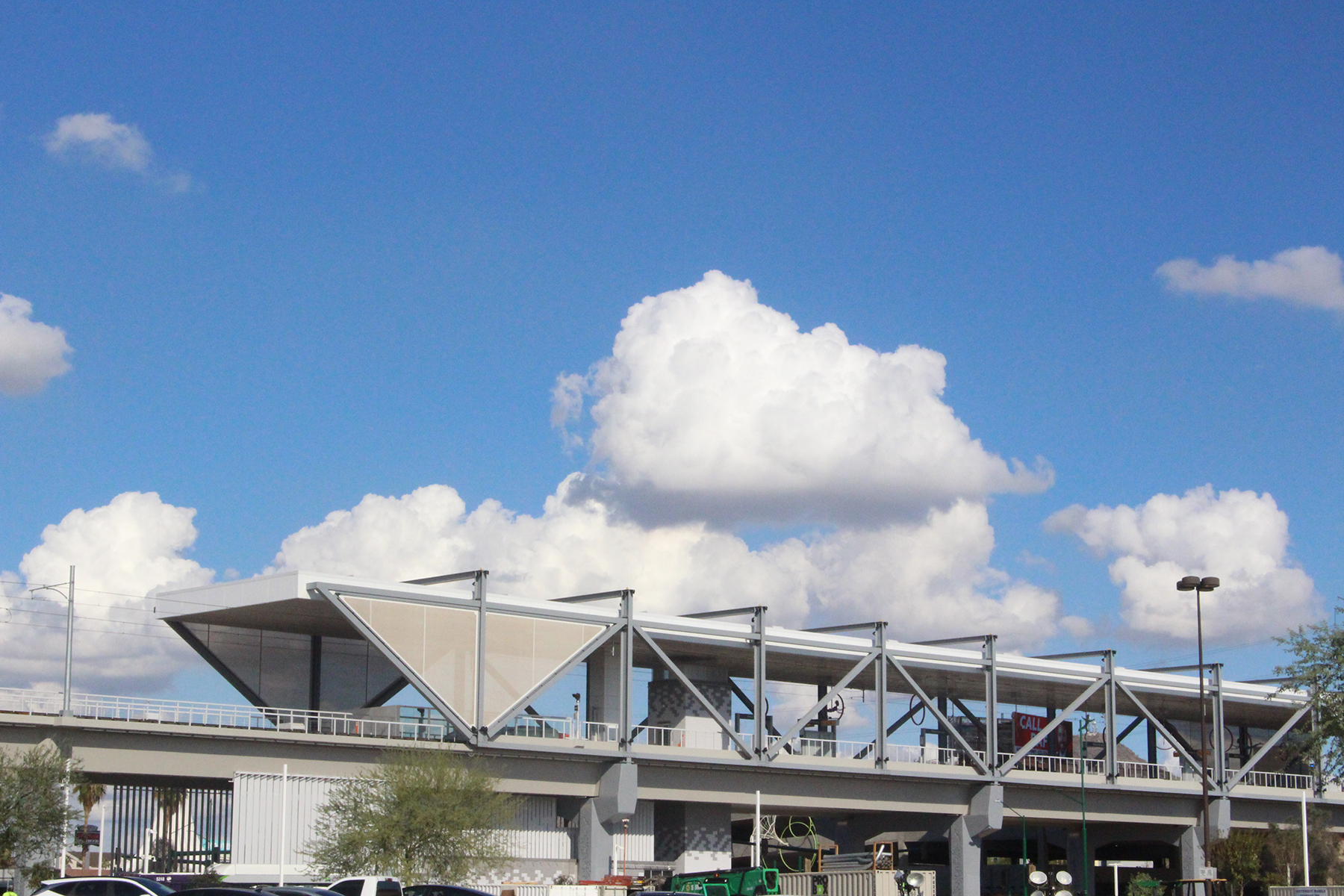
On Nov. 17, 2023, the City of Phoenix held a naming ceremony for the new Thelda Williams Transit Center, which includes an elevated light rail platform and is located at the former Metrocenter Mall – northwest of the I-17 and Dunlap Avenue. Light rail service at the new transit center will begin Jan. 27, and redevelopment of the mall area continues (photo by Kathryn M. Miller).
Other positive things taking place in the area are new murals, new light rail safety efforts, a thriving 19North Community Garden, with the Royal Palm Neighborhood taking the lead, and the expansion of the safety collaborations. Down the road, McBride says that Valley Metro is looking for ways to enhance the 19th Avenue/Dunlap transit station (“We need to activate it. It was meant to be a community space.”), and the Metro District is promoting a Superhero Saturday event that will take place from 10 a.m. to 4 p.m., Saturday, Jan. 13, at 9610 Metro Parkway West. But, she says, the biggest win for communities is always when collaboration happens.
“When I think back when I started 10 years ago, I did not see as much collaboration, you know, working outside of our silos — the city, Maricopa County, the police, businesses, neighborhood groups — it felt like to me it was much more siloed,” McBride said. “I’m seeing a much different approach becoming the norm. We’re doing this beautiful thing now where we really are saying, ‘Let’s do it together. Let’s collaborate our efforts.’ So that is a success. It means that everything we’re doing has that much more impact because we’ve got that many more parts pulling together.”
Learn more at www.19north.org or www.metrodistrictcollaboration.com.
Neighborhood Coalition of Greater Phoenix
Neal Haddad is one of scores of volunteers who work behind the scenes within multiple communities to advocate on behalf of neighbors. In addition to serving as president of the Arcadia Osborn Neighborhood Association, he is also the current president of the Neighborhood Coalition of Greater Phoenix, which was founded in 1985.
Last year brought a number of challenges — with some wins and some losses — and 2024 will likely be the same. In the “win” category Haddad includes the failure of several state housing bills, which his group and others opposed.
“Advocates of the bills call it zoning reform, but it’s really zoning deregulation,” Haddad said. “HB2536 (and others) tried to remove all local control from municipalities when it comes to zoning and review. All 91 municipalities in Arizona opposed these bills.”
At the municipal level, he cites the City of Phoenix’s move to create another option for housing affordability by allowing accessory dwelling units (ADUs). The Coalition worked to make the proposed text amendment better by clarifying different components (improving review and requirements for historic preservation properties) and by regulating ADUs so that they add to the housing supply and do not become short term rentals (www.phoenix.gov/ADU).
Another 2023 City of Phoenix proposed text amendment focused on reduced parking for multifamily housing citywide, and the Coalition advocated through Village Planning Committee meetings to limit where reductions are in place.
“After a long, arduous process that began in July and will culminate in a City Council vote scheduled for Jan. 24, City Council seems set to limit parking minimums only in the most transit-friendly areas of the city (mostly downtown),” Haddad said.
Housing was the hot topic of 2023, and Haddad says that everywhere you turn you hear, “We are in a housing crisis!” but he contends that many shouting “crisis” have something to benefit from financially.
“Neighbors and neighborhoods are cited for ‘being against everything.’ It’s not true,” he said. “In more than a dozen years being a neighborhood advocate, I don’t think I have said once ‘you can’t build here.’ My position and that of the people I work with in the Neighborhood Coalition is to find a reasonable and thoughtful development.
“At this point, what we see are developers who don’t want to be questioned and don’t want to work with neighbors, other than minor changes that ‘nibble around the edges.’ Those that work with neighbors in defining what a neighborhood will look like will be rewarded with stronger projects. Those who don’t genuinely work with neighbors will find their work infinitely more challenging to advance.”
Haddad added, “Great things can happen when people talk to each other. We live in a participatory democracy. We will continue to seek an audience with decision makers so that we can help shape a stronger, more vibrant neighborhood, city and state.”
Residents who would like to connect with the Neighborhood Coalition of Greater Phoenix can send an email to ncgphx@gmail.com.
Transforming Phoenix neighborhoods in 2024, and beyond
Finding consensus within Phoenix’s diverse neighborhoods can be a challenge, but all of the neighborhood leaders we spoke with agree: given the positive things that can happen when neighbors work together on common goals, residents might want to consider adding “get involved in a neighborhood group” near the top of their list of New Year’s resolutions.
To find or create a neighborhood organization, learn more about programs, grants and services available to your neighborhood or to connect with your City of Phoenix Neighborhood Specialist, start by visiting www.phoenix.gov/nsd.