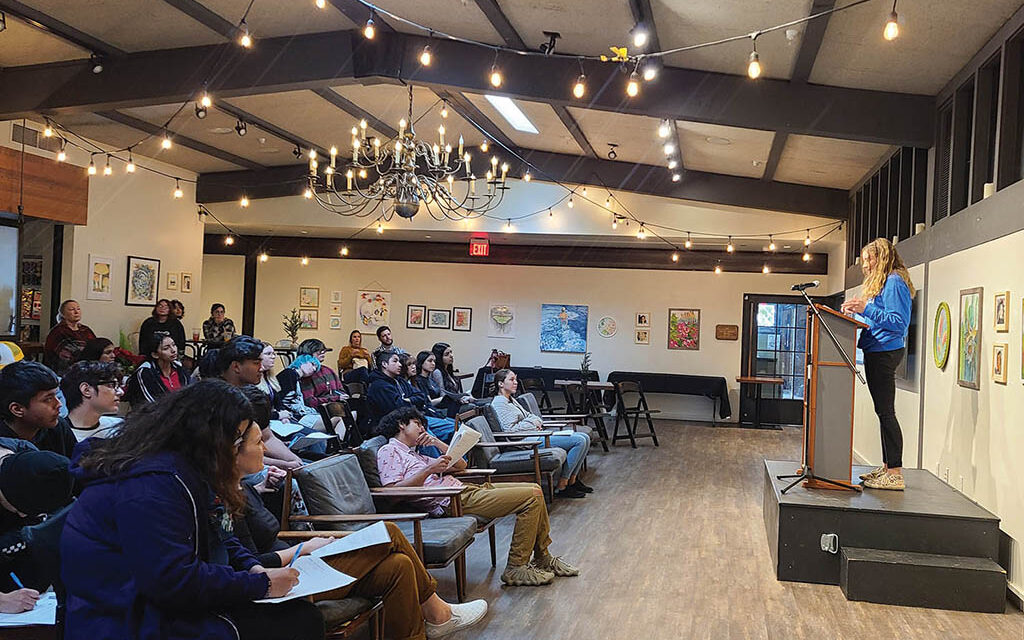
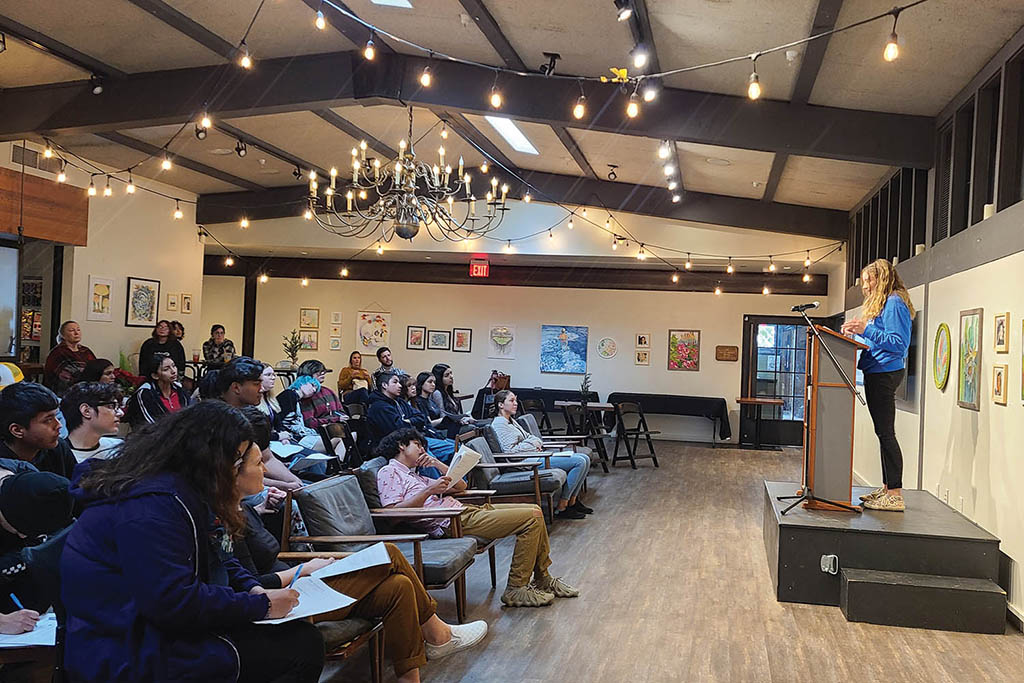
A Camelback Montessori College Preparatory junior participates in one of the unique learning experiences the school offers – performing her personal narrative on stage in front of peers and families in a public setting (submitted photo).
Before 2012, families in Arizona seeking to continue a Montessori education beyond middle school had no public options – Montessori secondary programs ended after eighth grade.
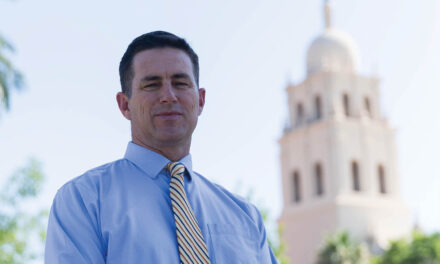
“The vision behind Camelback Montessori was simple but ambitious,” said Danchi Nguyen, Micro-School Leader, “to extend Montessori philosophy through high school in a tuition-free, public setting and to reimagine what high school could look like for adolescents by pairing rigorous academics with a learning environment that fosters independence, creativity and purpose.”
Camelback Montessori College Preparatory (CMCP) opened its doors in 2012 as a micro-school embedded within Camelback High School, enrolling 24 students and sending two pioneering teachers through the Cincinnati Montessori Secondary Teacher Education Program, home to the first public Montessori high school in the nation.
Today, the school serves 180 students within a campus of nearly 2,000 and is staffed by six teachers, a dedicated counselor and led by Nguyen.
“The small size allows for deep relationships while the large campus allows rich opportunities,” she said. “CMCP students participate in year-round athletics, choose from 70 and growing campus clubs, and frequently step into leadership roles that serve the entire student body – from Student Body president to lead cadet of JROTC to president of National Honor Society.”
Inside a Montessori classroom, learning begins in familiar ways. The teacher reviews a visual agenda, outlines choices for the day, and may launch into a short whole-class mini-lesson. From there, students take ownership of the remaining 100-minute learning block as teachers circulate to confer, coach and observe.
In English, students lay sentence strips across the floor, physically moving semicolons as part of hands-on ACT preparation. Across the hall, juniors are circled, debating the merits and flaws of the Electoral College. The room feels structured yet alive, marked by intentional choices, quiet conversation and sustained focus.
“All coursework is honors-level and college-preparatory, designed to demand both depth and independence,” Nguyen explained.
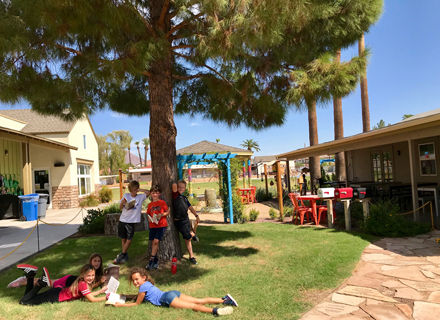
Learning outside the classroom pushes students beyond their comfort zones and away from technology. Sophomores sleep overnight during multi-day camping experiences, learning to cook meals using only two propane griddles, and applying math through orienteering challenges with compasses. At night, they gather by headlamp for Socratic seminars, discussing Maslow’s hierarchy of needs and adolescent development in the dark. Biology lessons unfold outdoors, where students learn to fish while studying Arizona ecosystems.
“The work of the hands and heart is equally central,” Nguyen added. “Students hand-tie hundreds of blankets each year for local homeless shelters, read weekly to peers with exceptional learning needs, and assist custodial staff with post-lunch cleanup. Through both large acts and small gestures, students learn to create the world they want to see.”
College preparation culminates in voice. Juniors craft Humans of New York–inspired narratives, then stand on stage, microphone in hand, performing their personal statements for peers, families and community members. They learn listening is an act of love and everyone has a story and know their community is one of trust and vulnerability.
The outcomes reflect the impact, Nguyen said. In the Class of 2025, 76 percent of students identified as first-generation college-bound, 91 percent enrolled in a two- or four-year college, and seniors earned $7.7 million in scholarships, with one-third attending selective colleges out of state, including Williams, Swarthmore, Washington University, Colgate and Davidson.
“Camelback Montessori College Preparatory represents what is possible in public education when adolescents are trusted with responsibility, supported by structure, and challenged to truly see themselves – and their power to build the communities they want to see,” Nguyen added.
Learn more about the school by calling 602-764-7000 or visiting www.pxu.org/o/cms.