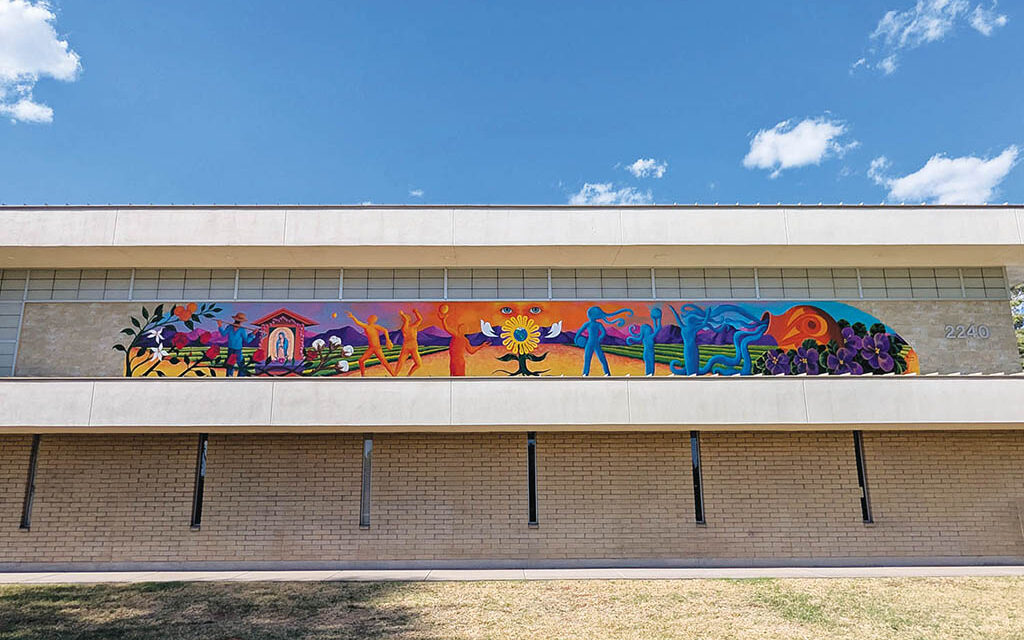
A new mural by Arizona artist Martin Moreno graces the gym building exterior at Washington Activity Center and celebrates the deep and rich cultural history of the area, historically known as Barrio Santa Rosa (photo by Kathryn M. Miller).
At an April 1 community event, residents in the Washington Park neighborhood gathered to celebrate recently completed renovations at the city’s Washington Activity Center, located at 2240 W. Citrus Way. While neighbors young and old oohed and aahed at the many updates, it was a new mural that brought residents together to reflect on the neighborhood’s past and future.
The renovations were part of the NCAA Women’s Final Four Legacy Project presented by Dove, which serves to revitalize recreational spaces such as parks, community centers or facilities in historically underserved areas. The Washington Activity Center was transformed with a beautifully refurbished indoor basketball court, a new computer lab, a teen lounge, a cozy literacy lounge with hundreds of Scholastic books and that outdoor mural, created by local artist Martin Moreno.
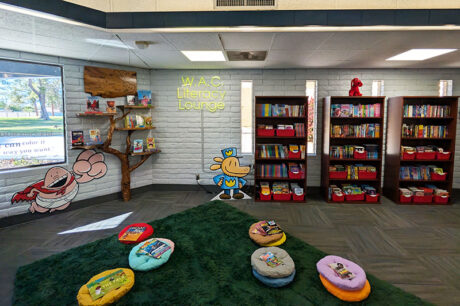
A cozy new literacy lounge, stocked with hundreds of Scholastic books, was created as part of the recent upgrades at Washington Activity Center (photo by Kathryn M. Miller).
The April event also served as a recognition of the area’s cultural heritage, and the mural was designed to help tell the story of the Barrio Santa Rosa. A brief history of the neighborhood provided by District 5 Councilwoman Betty Guardado’s office told the story of how, in the early 20th century, Hispanic families moved into the agricultural belt south of the Arizona Canal, many working on area lettuce, cotton and citrus farms.
While some lived on farms where they worked, others, like the Luis Flores family, purchased land near 19th and Glendale avenues to settle and raise families. As the post-World War II population boomed, land was purchased and subdivided, including the W.J. Lawrence Tracts, platted between 19th and 21st avenues with the through streets of Lawrence and Ocotillo roads. Small businesses, like Henry Ong’s Farmer’s Super Market on 19th Avenue were opened to serve residents.
The community identity was further cemented by the establishment of the Santa Rosa Catholic Center, and on the feast of Our Lady of Guadalupe on Dec. 12, 1948, Reverend Ernest Wilson celebrated the first mass in the Santa Rosa community. Remnants of the center remain, as do the memories of longtime residents like Pio Garcia, who recalled the John Jacobs Farms on 19th and Peoria avenues, where residents harvested potatoes.
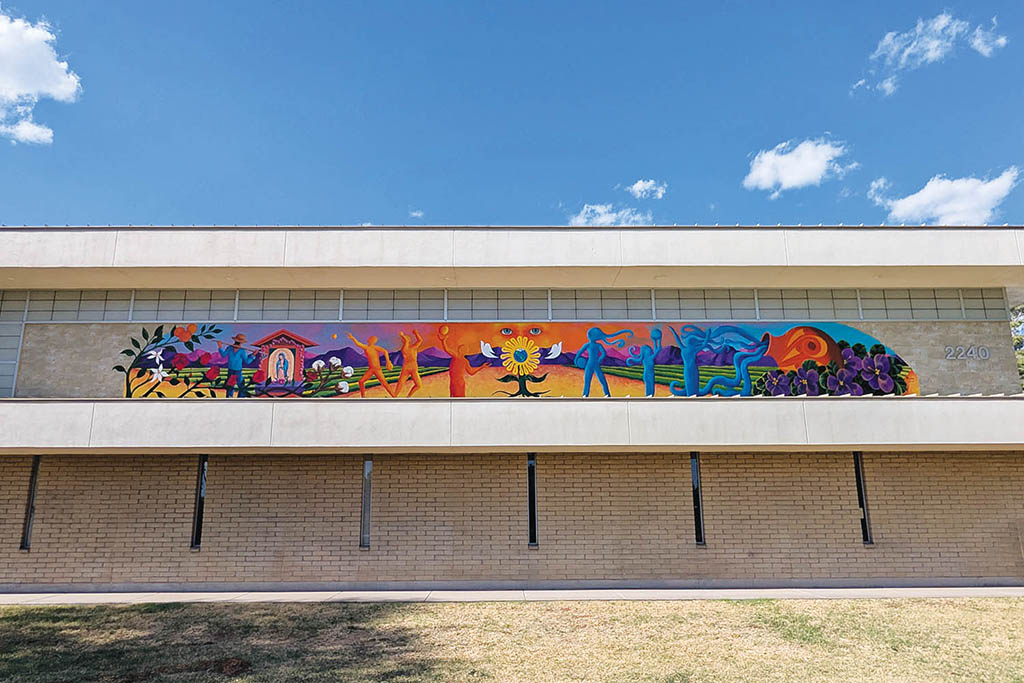
All of this history and more is reflected in Moreno’s mural, which unfolds as a continuous visual narrative. At the left, the artist pays tribute to the local community with the American Rose, which holds deep cultural significance within Mexican American communities, he said. Other imagery includes orange blossoms and cotton fields and an ofrenda (alter) that serve as historic reminders of the barrio, along with field workers, mountain ranges and a floral composition inspired by pre-Columbian design. To the far right, an ancient Hohokam water vessel pours water into the historic canal systems that continue to serve the region today.
The elements all come together to celebrate life, balance, continuity and harmony – along with the communal spirit embodied by the activity center.
In his written narrative, Moreno says, “Together, these elements create a cohesive mural that honors the past, celebrates the present and looks forward to the future – reflecting the Washington Activity Center as a place of connection, movement and shared cultural heritage.”
Helping steer the neighborhood’s future is a group of actively involved neighbors, led by Sarah Curtiss, president of the Washington Park Neighborhood Association, whose boundaries run from Glendale Avenue and Bethany Home Road, 19th Avenue to the I-17.
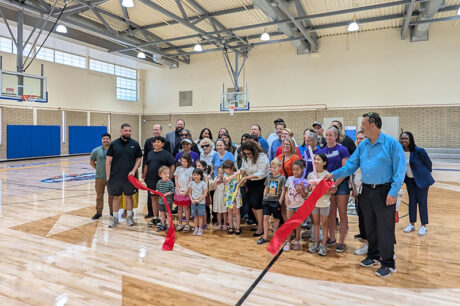
District 5 Councilwoman Betty Guardado joined community members at an April 1 ribbon-cutting event inside the newly refurbished Washington Activity Center gym (photo by Kathryn M. Miller).
Curtiss was in attendance at the April 1 event, which was also attended by Moreno, Guardado and dozens of neighbors who came out to tour the updated activity center, view the mural and enjoy gathering with friends and family. Curtiss, along with other community members, served on the committee that helped bring the Legacy Project to their community.
“This community center is used by toddlers for the music programs. It is used for the junior basketball league, indoor soccer, chair yoga – it is used by so many people from toddlers to seniors every day. The updates will bring more people here – we’ve got the high school and the elementary school right there – and this will give them a safe place to go after school with actual activities.”
Curtiss has lived in the neighborhood for more than six years and says that the light rail initially drew them to the community.
“We were moving back from China and we wanted to keep to one car. My husband and I are used to public transportation and when he was doing his MBA at ASU, he wanted to be able to take the light rail. We were looking at different neighborhoods and what made us put an offer on the house is that we had met all of the neighbors before we even put in the offer.”
The amenities at the activity center and Washington Park itself were also a big plus, but “What keeps us here is the community,” Curtiss added.
Many of the current neighbors are related to the original Santa Rosa Barrio farmworkers, and it is that continuity and cultural history, as well as the new connections that are being made, that keeps the neighborhood thriving. And Curtiss encourages other neighbors – whether longtime or newcomers – to get involved with the neighborhood association, which meets the second Tuesday of the month at the activity center.
“We focus on safety, what is happening in the neighborhood – things like that,” Curtiss added.
Connect with the Washington Park Neighborhood Association by sending an email to washingtonparkphx@gmail.com or on Facebook, @washingtonparkneighborhood. To learn how to get involved with a group in your area, or to organize your own neighborhood association, visit www.phoenix.gov/administration/departments/nsd/get-involved.html.