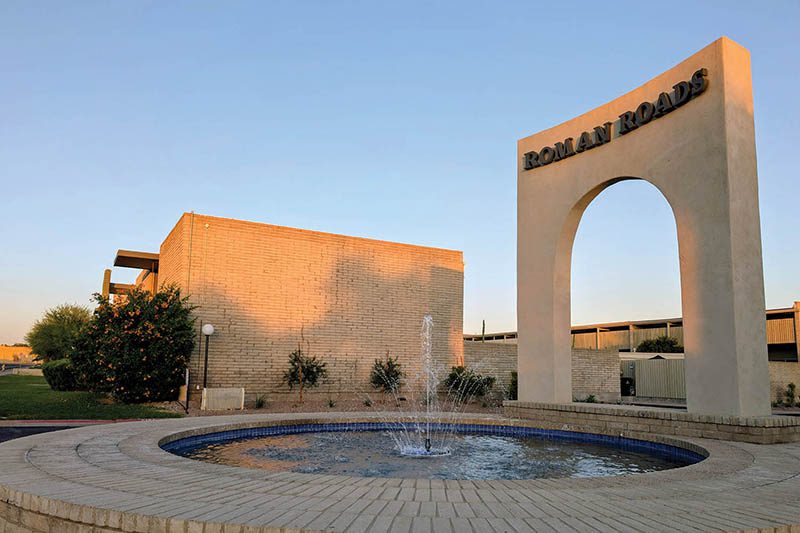
Designed by famed architect Al Beadle and built between 1964 and 19070, owners at the Roman Roads complex will seek to preserve the mid-century property for the next generation as it pursues Historic Preservation Overlay zoning through the city of Phoenix (photo by C. Miller).
Already recognized on the National Register of Historic Places, Roman Roads is now seeking Historic Preservation Overlay zoning from the city of Phoenix – a move that will help preserve the mid-century property for the next generation.
Why is Roman Roads deserving of preservation? Rachel Simmons, the driving force behind the zoning request and an owner of one of the 24 condominiums, can answer that question with three words: “It is iconic.”
Located on Maryland Avenue, just east of 16th Street, Roman Roads is identified by a dramatic arch and fountain that greets residents and visitors alike. The multi-family project was “masterfully designed by architect Al Beadle to provide all of the privacy of single-family living with the amenities of condominium life,” Simmons wrote in an article for Modern Phoenix.
“There were only supposed to be 12 units; the first five were built in 1964, designed by Beadle,” she told us. “Then, in the late ‘60s, they hired Gene Buckley to do a floor plan redesign and the last building was built in 1970.”
Simmons elaborated on some of the striking architectural features that she feels make Roman Roads iconic.
“The design is Modernism, which is what Beadle did,” she said. “Each unit is about 20 feet tall, and at the center of the interior, it reaches that full ceiling height, with huge windows that look out to a back courtyard. Each unit has its own cocktail pool and a big covered patio that serves as exterior living space – it is so integrated into the interior through the glass. And then he designed privacy screens that extend towards the back of the patio so that nobody can see into each other’s back yard, even if you are upstairs looking through the window.”
The building fronts also have the 18-foot windows – that window design later had to change in order to get a building permit. All of the Beadle units also have a floating staircase with a “catwalk” connecting the upstairs bedrooms – the Buckley redesign features an L-shaped staircase.
Simmons, who is a member of the American Society of Interior Designers and the program director for Interior Design at Scottsdale Community College, says that Beadle’s architecture is important to Arizona.
“He definitely had a style, and I think that is part of what makes him unique and special to Arizona,” she said. “He was working in Mid-century modernism, but I would say closer to Heroic authentic modernism, with rectangular and square forms. He worked really hard to create functional living spaces for people and integrate the interior with the exterior.”
He designed beautiful large-scale homes but was also interested in multi-family, she added. And he designed the only Case Study here in Arizona – The Triad Apartments, built in 1962 at 28th Street and Turney Avenue, “An opportunity to explore how people can live in smaller footprints, but still live very well.”
Through her master’s work at ASU, she explored the redesign of mid-century architecture (which she generally defines as from 1947 to 1965) during a time in Phoenix when “there was a big building boom before the bubble, and everybody was buying up these cool mid-century houses and tearing them down. I really wanted to explore ways to update the homes so that people could appreciate them more.”
It is that desire to cultivate appreciation that is moving Simmons to pursue historic preservation zoning. As the proposed rezoning case moves through the hearing process, Simmons also reflected on historic preservation in Phoenix more broadly.
“What is interesting about the approach to historic preservation is that preservationists often have more conversations on what we should tear down than what we should save. We don’t think everything is savable. We are realistic about it and what we try to do is to allow a city to develop its own story and tell its own story. We do want to see architectural growth, but by picking out the right buildings from the right time periods, that really reflect that time period, is how we develop that story.”
She added that preserving buildings like this creates interest in the city and draws people to the city.
“Historic preservation develops a sense of place. It tells the story of the city. It gives us visual interest – we don’t want everything to look the same. But we do want Roman Roads to last for future generations.”
The Historic Preservation Commission will consider the Roman Roads case (number Z-35-26-6) on Monday, June 15, at 4:30 p.m. It will then go to the Camelback East Village Planning Committee on July 7, the Planning Commission on Aug. 6, and the Phoenix City Council on Sept. 9. Learn more at www.phoenix.gov/administration/departments/pdd/historic-preservation.html.