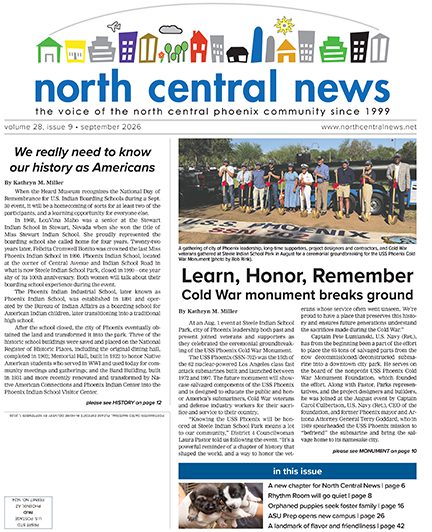
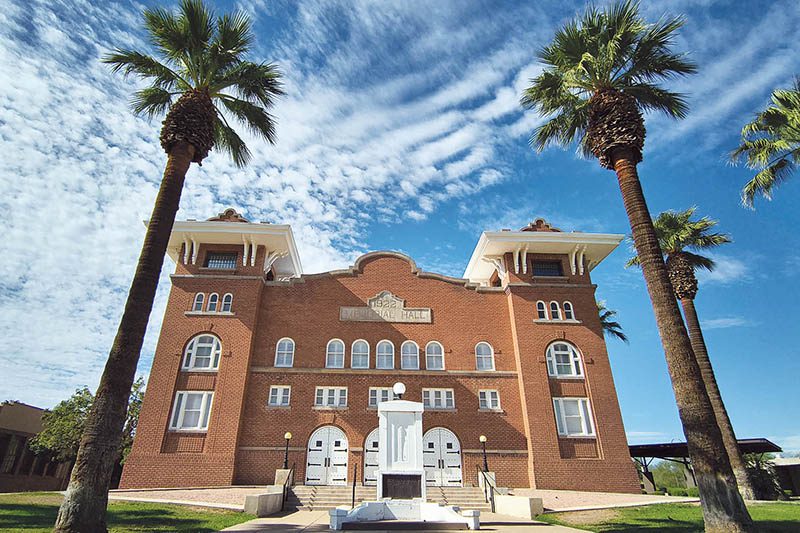
Built in 1922, Memorial Hall at Steele Indian School Park is one of three historic buildings on site that are remnants of Phoenix Indian School, a boarding school established in 1891 for the forced assimilation of Native American children (photo by Caitlin Miller).
When the Heard Museum recognizes the National Day of Remembrance for U.S. Indian Boarding Schools during a Sept. 30 event, it will be a homecoming of sorts for at least two of the participants, and a learning opportunity for everyone else.
In 1968, LouVina Maho was a senior at the Stewart Indian School in Stewart, Nevada when she won the title of Miss Stewart Indian School. She proudly represented the boarding school she called home for four years. Twenty-two years later, Felicita Cromwell Bonito was crowned the last Miss Phoenix Indian School in 1990. Phoenix Indian School, located at the corner of Central Avenue and Indian School Road in what is now Steele Indian School Park, closed in 1990 – one year shy of its 100th anniversary. Both women will talk about their boarding school experience during the event.
The Phoenix Indian Industrial School, later known as Phoenix Indian School, was established in 1891 and operated by the Bureau of Indian Affairs as a boarding school for American Indian children, later transitioning into a traditional high school.
After the school closed, the city of Phoenix eventually obtained the land and transformed it into the park. Three of the historic school buildings were saved and placed on the National Register of Historic Places, including the original dining hall, completed in 1902; Memorial Hall, built in 1922 to honor Native American students who served in WWI and used today for community meetings and gatherings; and the Band Building, built in 1931 and more recently renovated and transformed by Native American Connections and Phoenix Indian Center into the Phoenix Indian School Visitor Center.
The history of government run boarding schools is layered with nuances, the museum says – from how the students were treated, what they learned and didn’t learn, how they were prepared for life after high school and how boarding school impacted their cultures. But at the heart of that history, says Patty Talahongva, is pride, resilience and community.
Talahongva, programming and engagement officer for the Heard Museum, is Hopi and between 1978 and 1979 she attended Phoenix Indian School, as did generations of her family before her.
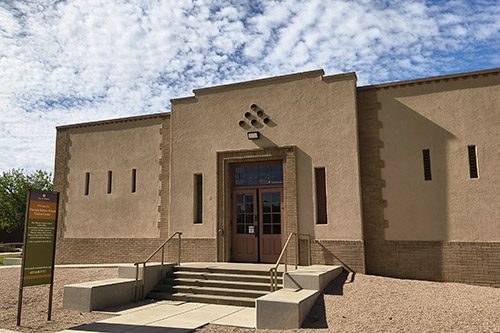
The Phoenix Indian School Visitor Center, housed in one of three Phoenix Indian School buildings that have been preserved, invites residents to learn the history of the students who passed through its doors (photo by Caitlin Miller).
“I am what’s commonly referred to as a boarding school survivor and I really think people don’t understand what that means,” she said.
For decades, the schools were part of a government policy that was meant to assimilate and eradicate Native cultures. The children were taken away from home to a place where they couldn’t speak their traditional languages, practice their religions, wear their own clothing or even eat their own their food. And it is estimated that more than 3,000 children died while in government custody at schools across the U.S.
Eventually, times changed; attitudes changed. A place meant to eradicate culture become one where culture was celebrated. By the time Talahongva attended the school, speaking ones’ native language was encouraged; the Miss Indian pageants became a source of pride and shared community. But being away from home is never a good thing, and the lasting impact of low education standards and displacement can still be felt in communities she says, which is why the Remembrance event is important.
“It is history that is not taught about in public schools, and we really need to know our history as Americans…what our government is capable of doing,” Talahongva said. “I think people just don’t understand this part of history and how it has impacted Native peoples. It’s important to educate them, to let them know we are still here, despite all of the policies our government has had to annihilate us, assimilate us, relocate us. And yet we are still here. We will always be here. This is our homeland. This is where we come from. We’re not going anywhere.”
For the second year, Heard Museum is partnering with the Phoenix Indian School Visitor Center/Native American Connections for the Remembrance event, held this year on Sept. 30 from 10:30 a.m. to noon and including a visit to the former school grounds. In tandem, on view at the museum is “Away From Home: American Indian Boarding School Stories,” an updated installation of the long-running Boarding School exhibition, which takes a deeper dive into the history.
Heard Museum is located at 2301 N. Central Ave. For additional information, visit https://heard.org or call 602-252-8840.