
Dogs shaking their heads or cats pawing at their ears and meowing loudly can be signs of an ear infection. Veterinarians say the common condition is notoriously difficult to resolve.
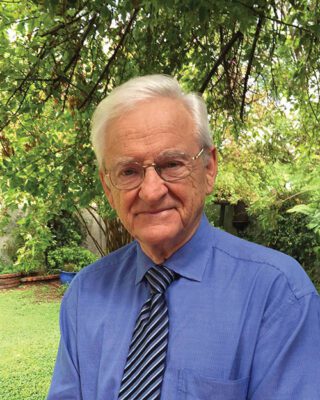
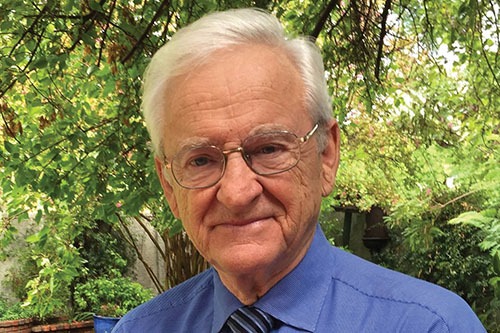
North Central resident Dr. Gabor K. Vajda, 91, may have retired from daily veterinary practice, but not from innovation – his latest invention is headed to field trials (photo courtesy of Gabor Vajda).
Longtime Phoenix veterinarian and North Central resident Dr. Gabor K. Vajda has spent decades solving problems like this.
Vajda’s story began in war-torn Hungary, where he was a veterinary student. At 19, he fled the Hungarian Revolution of 1956 for the United States with help from Americans. He earned his veterinary degree from Iowa State University in 1961. He and his wife, Eva, have two children and have cared for generations of family pets.
“I always wanted to pay back for all the kindness and support I received,” he said.
A past president of the American Animal Hospital Association and a recipient of multiple professional awards, he practiced for more than 50 years, including at Northern Animal Hospital on west Northern Avenue. He retired from daily practice, but not from innovation.
Vajda, 91, acknowledged that medication rarely reaches the true source of infection, leading to chronic cases that can linger for months or years. He decided the profession needed a better tool.
“I always had difficulty treating ears because of the unique structure of the ear canal,” he said. “When people clean the ears with their finger, or when you put some cleaning agent or medicine in it, it never goes beyond the outside. The moment the dog shakes the ear everything comes right out.”
He invented DexCath-G Gabor Catheter, a flexible, soft‑tipped catheter designed specifically for the canine and feline ear canal. Developed in collaboration with Portland, Oregon-based Dextronix Inc., a supplier of veterinary pacemakers and other medical devices, the catheter is built to deliver medication precisely where traditional treatments cannot reach.
With the “very soft, flexible catheter,” Vajda said, veterinarians can reach the end of the vertical canal and allow medication to flow into the horizontal canal, where infections often originate.
“It has millimeter measurements so the veterinarian can measure the length, how far to go in the ear canal,” he said. “There’s a landmark inside called the dorsal ridge, and another mark on the outside. You can measure from the outside how far you’re going in.”
Vajda added that inserting anything into the horizontal canal can damage the eardrum, “So, we deposit the medication at the end of the vertical canal,” he explained. “When a dog shakes its head, it pulls the ear up before it shakes, and that actually moves the medication down to the area where the problem is.”
The catheter has cleared clinical safety trials and is now entering its final regulatory phase. To complete that phase, Vajda and his collaborators are conducting mandatory field trials at Northern Regional Veterinary Hospital. The trials are led by Dr. Darius Starks, the hospital’s medical director. Starks explained that he helped develop marketing concepts and color schemes for the product. He also allowed Vajda to try the catheter on his dog.
“He’s done a lot – from being a business owner and entrepreneur to research on reproductive medicine. Leaving a piece of equipment named after him really will be the culmination of his veterinary career,” said Starks.
The field trial involves dogs and cats with acute or chronic ear conditions. The team is seeking referrals from veterinarians and pet owners across the Valley.